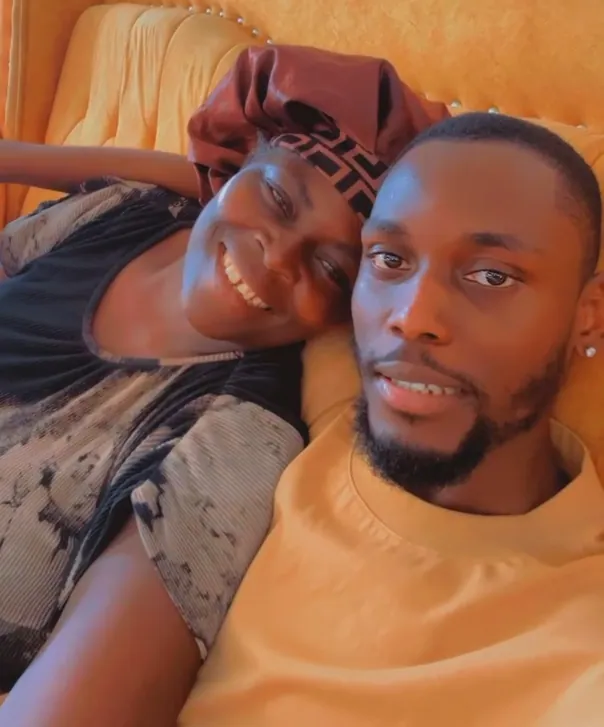
My father, Stephen Nwaorisa, is a serious man in the way Igbo fathers of his generation are serious: work, church, the family name, the school fees paid on time even when it meant going without. I learned from him that a man is measured by what he provides. It took me a long time to learn that he was also teaching me something he did not intend, which is that a son who cannot become what his father provides for is a son with a problem to hide.
My mother is Ngozi Obi. If you have read Biafra Rising, you have read her; she wrote it with me under the name Blessing Ngozi Obi, and the woman on the cover, beside me in the maroon head-tie, is her. She is the one who told me the war stories when I was small, who kept the family fed through the years when the light went off more than it came on, and who is still, today, the person I call first.
My mother did not have to understand me to stand next to me. She stood there first, and understood later.
Four of us
Francis Nzube is the eldest. He carried the weight that eldest sons carry in our families, of being the example, and he carried it well. Eudora Chisom is my sister, quicker than all three of her brothers and never shy about saying so. Charles Uchenna is the youngest, the one I taught to ride a bicycle in the sand between the blocks at Obinze, the one who used to follow me everywhere.
What each of them thinks of who I am is theirs to say, not mine. I will only say this: a family in Nigeria that has a gay son is put in an impossible place by the country, by the church, and by every neighbour with an opinion. I have tried to write about that place with honesty in the books, and where I changed names it was to protect them, not to punish them.
The house at D10
Army Housing Scheme, Obinze, is what it sounds like: blocks of housing built for soldiers' families along the road south of Owerri, later filled by everyone else. Ours was D10. Two rooms that were never enough, a veranda where my mother sold things some years, a generator that we could not always fuel, a church a short walk away and a school a longer one.
I have a photograph of the front of that house in my head that I have never taken. Red earth, a wall the colour of dust, a mango tree, washing on the line. If you drive out of Owerri toward Port Harcourt you pass it without knowing. Everything I am was decided within a few hundred metres of that veranda.
Why I name them
Because a person who is erased is erased from a family first. When people in Nigeria disappear for being gay, the story that is told afterwards is that they had no one, that they came from nowhere. I came from somewhere. I came from Stephen and Ngozi, from Francis, Eudora and Charles, from D10 in Obinze. I want that written down where it cannot be deleted.