
The Night the Trains Stopped Running
September 1966. Northern Nigeria.
A train from Kano pulled into a station at dusk, its carriages packed with Igbo families desperate to escape south. They carried bundles of belongings hastily tied with rope—photographs, children’s clothes, documents proving land ownership back home. Some clutched rosaries. Others held Korans. Religion didn’t matter anymore. Only one thing mattered: they were Igbo, and that had become a death sentence.
The train never made it past that station.
What happened next would be repeated at stations across the North. Mobs surrounded the carriages. Soldiers looked away. Police disappeared. The screaming began just after sunset and didn’t stop until dawn.
Survivors who made it to the East spoke in fragments. Their words came out broken, like shattered glass impossible to piece back together. “They pulled my husband through the window.” “I covered my daughter’s eyes, but I couldn’t cover her ears.” “The conductor locked us in. He locked us in and walked away.”
This wasn’t chaos. This was choreography.
A Nation Built on Lies
The promise of Nigerian independence in 1960 had been beautiful in theory. Three regions—North, West, and East—united under one flag, one anthem, one dream. Lord Lugard’s 1914 amalgamation had forced disparate peoples into artificial borders, but surely, the optimists believed, time would make it work.
By 1966, that lie had calcified into bitter truth.
The Igbo people had believed in Nigeria perhaps more than anyone. They’d spread across the nation—traders in Lagos, civil servants in Kaduna, teachers in Sokoto, railway workers in Jos. They’d invested not just money but faith in the Nigerian project.
That faith was repaid with blood.
The coup of January 15, 1966, though led primarily by young Igbo military officers, had aimed to save Nigeria from corrupt politicians. Major Chukwuma Kaduna Nzeogwu’s idealistic manifesto spoke of ending tribalism and corruption. Instead, the coup’s failure—and the predominantly Northern casualties—became the excuse needed to unleash what had been simmering for years.
The counter-coup of July 1966 was revenge dressed as patriotism. General Aguiyi-Ironsi, Nigeria’s first Igbo head of state, was tortured and killed. Igbo officers were hunted down in barracks across the nation. The killing spread from the military to civilians.
By September, it had become a pogrom.
The Mathematics of Genocide
How do you count the uncountable?
Official records list 30,000 dead. Survivors’ accounts suggest 50,000. Eastern Regional government reports, based on refugee testimonies and missing persons, estimated upward of 100,000.
But these are just numbers, and numbers lie by what they omit.
They don’t count the woman in Zaria who watched her children killed before being killed herself. They don’t count the mechanic in Jos whose name was crossed off a list before his body was pulled from a well three weeks later. They don’t count the unborn—babies cut from wombs in acts of cruelty so grotesque that witnesses couldn’t speak of them for decades.
The killing followed patterns:
- Identification: Igbos were identified by accent, tribal marks, or simply by lists provided to mobs
- Isolation: They were separated from their non-Igbo neighbors who might protect them
- Elimination: Carried out publicly, designed to terrify, designed to send a message
The message was received.
Between July and October 1966, an estimated two million Igbo people fled to the Eastern Region. They came on foot, by bus, in the back of trucks, on bicycles, carrying children on their backs. They came with machete wounds still fresh. They came with trauma that would echo through generations.
The Refugee Crisis No One Wanted to See
The Eastern Region, though the most economically viable part of Nigeria—producing the oil that fueled the nation’s economy—was not prepared for this human tsunami.
Schools became refugee camps. Churches became hospitals. Every household took in displaced relatives, friends, strangers. The stories they brought were uniform in their horror, varied only in their details.
Lieutenant Colonel Ojukwu, the Oxford-educated military governor of the East, was caught between impossible choices. The federal government, now led by Lieutenant Colonel Yakubu Gowon, offered no justice, no accountability, no guarantees of safety. Instead, it offered platitudes about “One Nigeria” while the bodies were still being counted.
Ojukwu convened the Consultative Assembly of traditional rulers, community leaders, and elders. The question before them was existential: Could Igbos ever be safe in Nigeria again?
The answer came not from politicians but from refugees. “We cannot go back,” they said. “There is nothing to go back to.”
May 30, 1967: The Declaration
The broadcast began at 8:00 AM. Radio Enugu’s transmitter carried Ojukwu’s voice across the Eastern Region and beyond.
His words were not triumphant. They were tired. Tired of begging a federal government to protect its citizens. Tired of explaining why Igbo lives mattered. Tired of pretending that “One Nigeria” was anything but a slogan used to justify inaction.
“Having mandated me to proclaim on your behalf, and in your name, that Eastern Nigeria be a sovereign independent Republic,” Ojukwu read, “I do hereby solemnly proclaim that the territory and region known as and called Eastern Nigeria, together with her continental shelf and territorial waters, shall henceforth be an independent sovereign state of the name and title of THE REPUBLIC OF BIAFRA.”
In living rooms across the East, people wept. Not from joy—there would be little joy in what came next—but from recognition. Someone had finally said what the pogroms had already written in blood: the Nigerian experiment, at least for the Igbo people, had failed catastrophically.
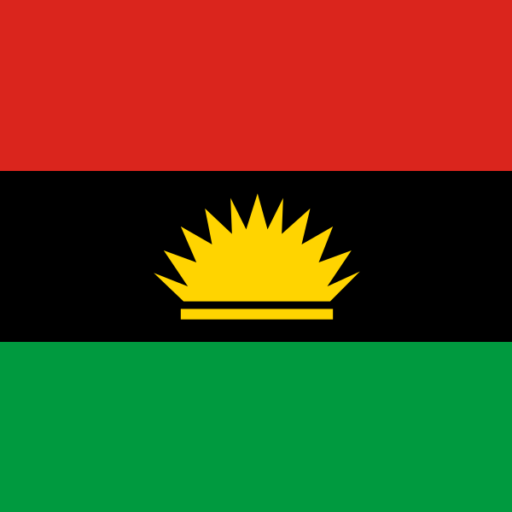
The new nation took its name from the Bight of Biafra, the Atlantic coastal region that had defined the area for centuries. The flag—a rising sun on horizontal bands of red, black, and green—was raised over government buildings.
The sun represented hope, but everyone knew the darkness was just beginning.
The International Community Looks Away
In Lagos, the federal government’s response was swift. Biafra was declared an illegal rebellion. The Eastern Region’s secession was an existential threat to Nigeria’s territorial integrity, and more importantly, to control of the oil fields.
Britain, the former colonial power, backed Nigeria. So did the Soviet Union. The United States maintained “official neutrality” that functionally supported Lagos. The Organization of African Unity declared that colonial borders must be respected—as if those borders weren’t colonial in origin.
A few nations broke ranks. Tanzania recognized Biafra. Gabon followed. Haiti did too. France provided covert support. Israel sent arms. But these were drops in an ocean of international indifference.
The world chose stability over justice, borders over people, oil over ethics.
By July 1967, federal troops had begun the invasion. The war that would kill over one million people, mostly through starvation, had begun.
The Question That Won’t Die
More than five decades after Biafra’s defeat in January 1970, the question remains: Was independence necessary?
For those who lived through the pogroms, who carried the dead, who fled with nothing, the answer is self-evident. How do you ask a people to remain in a nation that had just demonstrated—systematically, publicly, without consequence—that their lives held no value?
The Nigerian government promised reintegration, reconciliation, “No victor, no vanquished.” But wounds that deep don’t heal with slogans. The structural issues that made the pogroms possible—ethnic politics, resource inequality, fundamental disagreements about federalism—were never truly addressed.
Today, the debate continues. IPOB (Indigenous People of Biafra) agitates for a new referendum. The Nigerian government responds with force. The cycle of grievance and suppression continues, different in scale from 1966 but familiar in pattern.
Perhaps the real question isn’t whether Biafra’s declaration was necessary in 1967—the pogroms had already answered that. The question is whether Nigeria has done the necessary work to ensure such a choice never becomes necessary again.
The trains still run between North and South today. But the memories of the trains that stopped in 1966 remain, passed from grandparents to grandchildren, from survivors to a generation born long after the war.
Those memories ask a question Nigeria has never fully answered: Can you build a nation on the graves of those who believed in it most?
The sun on Biafra’s flag rose for only thirty months. But the questions it illuminated remain unresolved.