I was seven years old when my grandmother first told me about the war.
We were sitting under the udala tree in our compound in Enugu, and she was peeling cassava with hands that trembled—not from age, but from memory. “Nwa m,” she called me, her voice barely above a whisper, “let me tell you about the time they tried to kill us all.”
She told me about 1967. About the pogroms in the North where our people were slaughtered like animals. About pregnant women cut open, their unborn babies tossed into fires. About the blockade that turned Biafra into an open-air concentration camp. About children with swollen bellies and stick-thin arms, dying not from bullets but from calculated starvation. About 3 million souls—3 million!—who perished because they dared to say “we want to be free.”
My grandmother survived that war. But as I looked into her eyes that afternoon, I realized that part of her had died in it.
“They thought they killed Biafra,” she said, her voice suddenly fierce. “But you cannot kill a spirit. You cannot kill an idea whose time has come.”
This book is that spirit refusing to die.
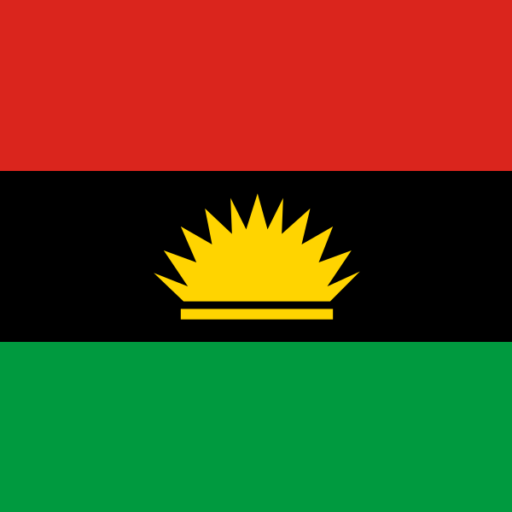
Fifty-eight years after the Biafran flag was first raised, fifty-five years after it was forcibly lowered, the fire still burns. It burns in the heart of every Igbo child who has been told they are “too Igbotic.” It burns in every young person who has watched their JAMB scores manipulated because they come from the Southeast. It burns in every family that has lost a son or daughter to Nigerian security forces, simply for demanding what the United Nations charter guarantees: the right to self-determination.
This fire burns in the body of Mazi Nnamdi Kanu, who has spent five years in chains—not for committing a crime, but for having the audacity to speak truth to power. It burns in Mazi Simon Ekpa, imprisoned in Finland for the “crime” of advocating for his people’s freedom. It burns in countless others locked in Nigerian dungeons, whose only offense was believing that Biafrans deserve to breathe free air.
This is not just a book about history.
Yes, you will read about the war of 1967-1970. You will learn about the systematic marginalization, the economic strangulation, the cultural erasure that has been Nigeria’s policy toward Biafrans for over six decades. You will see documented evidence of the double standards—how Boko Haram terrorists are “rehabilitated” and released while Biafran activists are tortured and imprisoned.
But more than history, this is a book about now. About this very moment when a people are rising from the ashes once again. About the mothers who march in the streets of London, New York, Tokyo, demanding freedom for their sons. About the youth who have turned social media into a battlefield, making #FreeMaziNnamdiKanu trend globally. About the Eastern Security Network (ESN) volunteers who risk everything to protect villages from Fulani terrorists while the Nigerian government calls them criminals.
This is a book about resistance—creative, persistent, unbreakable resistance.
Why I wrote this book:
I wrote this because the world needs to know. The mainstream media will not tell this story. International organizations remain silent while a people are systematically oppressed. The United Nations speaks eloquently about self-determination everywhere except when it comes to Biafra.
I wrote this because our children need to know. There is a deliberate attempt to erase Biafran history, to make the younger generation forget. They want our youth to be ashamed of being Igbo, to see their identity as a burden rather than a blessing. This book is my refusal to let that happen.
I wrote this because silence is complicity. Every day I remain silent, another Biafran youth is killed. Another family is displaced. Another activist is tortured. Another lie is told and goes unchallenged.
But most of all, I wrote this because I believe.
I believe in the inevitability of Biafra. I believe that no matter how long it takes, no matter how many of us they imprison, no matter how sophisticated their propaganda becomes, the truth cannot be suppressed forever.
I believe because I have seen it with my own eyes—from Lagos to London, from Owerri to Washington D.C., from Aba to Berlin—I have seen Biafrans who refuse to give up. Young people who have never experienced the war but carry its memory in their DNA. Professionals who risk their careers to speak out. Artists who weaponize their creativity for freedom. Ordinary people doing extraordinary things.
This book is organized into nine parts, taking you on a journey from the ashes of the Biafran War to the digital revolution of today’s resistance movement. You will meet the heroes—famous and unknown. You will hear voices from prison cells and protests, from Radio Biafra broadcasts and social media campaigns. You will understand why, despite everything, we declare:
“Nigerians we are no more. South-Easterners and South-Southerners we cannot become. Biafrans we must be.”
These are not just words. They are our identity. Our destiny. Our non-negotiable truth.
A note to international readers:
You might ask: Why should this matter to me? I am not Biafran. This is not my fight.
Let me tell you why it matters.
Because injustice anywhere is a threat to justice everywhere. Because the same international community that celebrates self-determination for Scotland, Catalonia, and Quebec suddenly goes silent when Africans demand the same right. Because the principle that allowed South Sudan, Eritrea, and East Timor to be born applies equally to Biafra.
Because if we allow one people to be systematically oppressed, silenced, and erased, we set a precedent that endangers all of us.
Because Biafra is not just a place—it is a principle. The principle that people have the right to determine their own destiny. The principle that might does not make right. The principle that no amount of propaganda can erase truth.
A note to my fellow Biafrans:
Some of you will read this book and remember. You will remember the war. You will remember loved ones lost. You will remember the hunger, the fear, the betrayal. And you will weep.
Others will read this and feel anger—righteous, burning anger at the injustice that continues to this day.
But I want you to feel something else too: hope.
Hope because we are still here. Despite everything they did to eliminate us, we survived. More than survived—we thrived. Biafrans are doctors, engineers, entrepreneurs, artists, scholars, leaders in every field, in every corner of the world. They tried to starve us to death. Instead, we built an economic engine that drives Nigeria itself.
Hope because the younger generation is rising. They are not intimidated. They are not silent. They flood social media with truth. They organize protests across continents. They refuse to be ashamed of who they are.
Hope because Biafra is inevitable. Not because it will be easy. Not because it will be quick. But because an idea whose time has come cannot be stopped by prison walls, propaganda, or even death itself.
This book is dedicated to:
The 3 million souls who perished in the Biafran War—your sacrifice was not in vain.
Mazi Nnamdi Kanu—your chains will break.
Mazi Simon Ekpa—Finland will answer for this injustice.
Every Biafran political prisoner—we have not forgotten you.
The women who lost sons, husbands, fathers—your tears water the tree of freedom.
The youth who carry the torch—the future belongs to you.
And to my grandmother, who planted that seed of truth under the udala tree—Nne, your story lives on.
The fire that never dies is not just in our hearts. It is in these pages. It is in every word of truth spoken against lies. It is in every protest, every broadcast, every tweet, every prayer for freedom.
They can arrest our leaders. They can ban our organizations. They can criminalize our flags. They can torture our activists.
But they cannot kill the spirit of Biafra.
Because Biafra is not just a place. Biafra is an idea. And ideas, once planted in the hearts of a determined people, are bulletproof.
Welcome to the story of a people who refuse to die. Welcome to the story of a fire that burns eternal. Welcome to the story of Biafra rising.
Blessing Ngozi Obi Nwaorisa
October 2025
Somewhere between memory and hope
Buy, read, share